


 English
 عربى
عربى
With the rapid growth of e‑commerce, cold chain logistics, and smart warehousing, the demand for durable logistics boxes (turnover bins) has soared. For injection mold manufacturers, the top concerns of buyers are impact strength and dimensional stability—specifically, how to produce boxes that withstand repeated drops, stacking, and severe temperatures without warping.
This article addresses the key technical points from material selection, mold structure design, cooling/ ejection systems, and process optimization to achieve a reliable, high-performance logistics box mold.
1. Material Selection – The Foundation of Impact Resistance
Logistics boxes are subject to stacking, handling, and drops during use, so the resin needs adequate impact toughness. Common choices are high‑impact HDPE or impact‑modified PP. Blends of HDPE and PP can increase stiffness and impact strength, and they are usable down to ‑25~‑30°C. For frozen supply chains, low‑temperature grades are available that do not crack at ‑40°C.
For the molds, the cavity and core are typically made of P20 or 718H (or higher) tool steel. If the customer specifies a better steel, it is purchased accordingly. Mold life correlates with steel hardness: P20 at about HRC 25 gives roughly 200,000 cycles; 718 at about HRC 30 gives roughly 400,000 cycles. Harder materials generally provide longer life, though actual life also depends on mold design and maintenance.
2. Mold Structure Design – Balancing Strength and Stability
The impact performance largely depends on rib geometry. Using CAE (Computer‑Aided Engineering) analysis, recommended rib height (typically 2–3 times wall thickness), spacing (30–50 mm), and draft angle (1–2°) can be determined. Well‑designed ribs not only increase rigidity but also minimize shrinkage‑induced warpage. Bottom and side ribs often adopt X‑shape, grid, or cross patterns to improve load‑bearing capacity.
Gate location, type, and number directly affect filling patterns and are major contributors to warpage. Multiple gates or fan‑shaped gates create multiple shrinkage centers that counteract anisotropic shrinkage, shorten flow length, and promote uniform density and shrinkage. Using Moldflow simulation optimizes the gating layout for balanced filling.
The handles of logistics boxes are stress‑concentrated areas during lifting. Poor venting in these zones leaves visible weld lines, which are prone to breakage. Proper venting design, guided by simulation, prevents air traps and ensures a sound weld line.
3. Cooling and Ejection Systems – Critical for Warpage Control
Non‑uniform cooling or insufficient cooling time is a primary cause of warpage. Cooling channels must be strategically placed to achieve balanced heat transfer. For large box molds (total weight up to 5 tons), strength and stiffness of the mold itself are also crucial; compact yet robust construction helps maintain dimensional accuracy.
Ejection‑induced stress can be minimized by increasing the number or area of ejector pins and providing adequate draft angles. Large boxes often employ four‑side opening with two‑stage ejection, using a peripheral ring ejector plate to achieve “surface contact” and evenly eject the part, effectively preventing bending and twisting.
4. Process Parameter Optimization – The Final Guarantee
Even a well-designed mold can produce defective parts with improper injection settings. Injection pressure, speed, melt temperature, and hold pressure must be fine‑tuned to balance fill and packing. If residual stress still causes warpage, reducing injection pressure, raising mold temperature, or applying an annealing process can relieve internal stresses.
Conclusion
Designing a high‑strength logistics box mold is a systematic engineering challenge—every step from resin choice to cooling, gating, and ejection influences the final product’s impact resistance and dimensional stability. Only by integrating material science, mold design, and injection process can we truly achieve a mold that produces boxes “impact‑resistant and warpage‑free.”
For customized mold solutions or technical consultations, feel free to contact our team.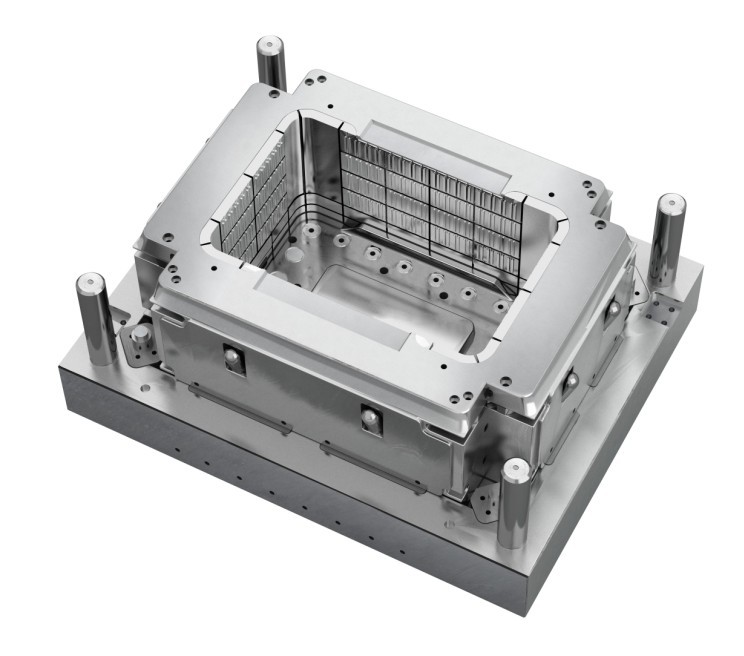
 86 - 576 - 84332017
 86 - 13634093909
 No. 85 Guangshun Street, Xinqian Street, Huangyan District, Taizhou City, Zhejiang