


 English
 عربى
عربى
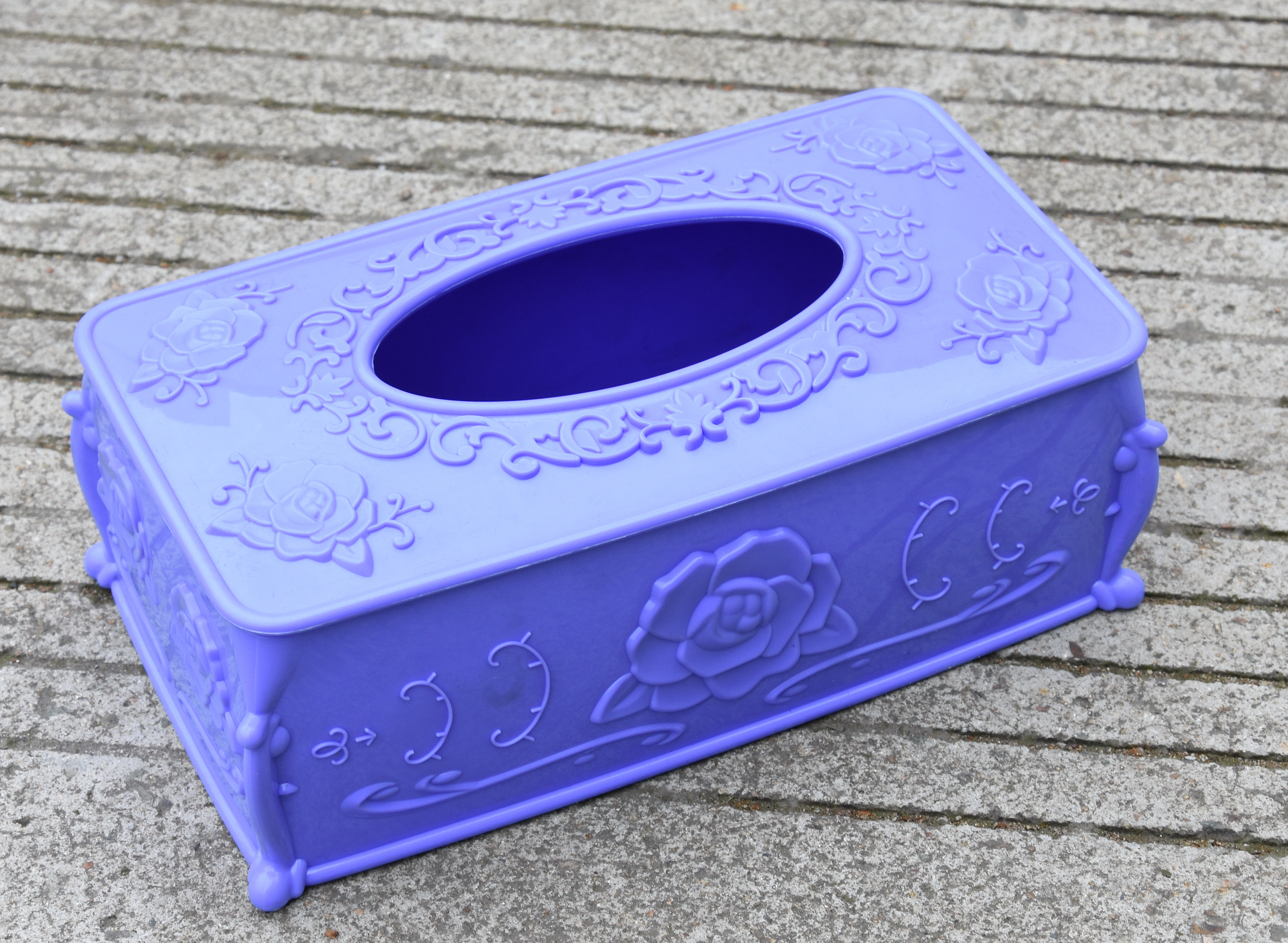
Plastic tissue boxes are widely used in household, commercial, and hospitality applications. The injection mold design for tissue boxes must produce parts with consistent wall thickness, smooth surfaces, and precise dimensions.
Mold Structure: Three‑Plate vs. Two‑Plate
Tissue box molds can be designed as either two‑plate or three‑plate molds. A three‑plate mold includes an additional stripper plate that allows the runner system to be separated from the part before ejection. This configuration is often preferred for tissue box production because it enables the use of a pin‑point gate located at the centre of the part, which leaves a smaller and less visible gate mark. The three‑plate mold also provides more flexibility in gate placement and runner design.
Cavity and Core Design
The cavity and core define the internal and external surfaces of the tissue box. The design must account for the part geometry, including the box walls, bottom, and the opening for tissue extraction. Draft angles are incorporated to facilitate part ejection, typically ranging from 0.5 to 2 degrees depending on the wall texture and material. The wall thickness is typically maintained within a narrow tolerance to ensure consistent strength and appearance.
Gate and Runner System
For tissue box molds, the gate system must deliver molten plastic to the cavity in a balanced manner. Pin‑point gates are commonly used in three‑plate molds to feed the cavity from the centre of the part. The runner system is designed to minimise pressure drop and material waste while ensuring consistent filling across all cavities in multi‑cavity configurations.
Cooling System
The cooling system in a tissue box mold must provide uniform heat extraction to maintain dimensional stability and minimise cycle time. Cooling channels are typically arranged around the cavity and core to follow the contour of the part. For larger tissue boxes, additional cooling lines may be required to ensure adequate cooling of deep sections. Cooling channel diameter and spacing are selected based on the part wall thickness and the mold material.
Ejection System
The ejection system must remove the finished tissue box from the mold without causing deformation. Ejector pins are typically arranged around the perimeter of the part and at locations where ejection force can be applied without leaving visible marks. For larger parts, ejector plates or push plates may be used to distribute ejection forces more evenly.
Mold Steel Selection
Tissue box molds are typically manufactured from pre‑hardened steel such as P20 or 718H. The mold steel must provide sufficient wear resistance for the expected production volume while maintaining good machinability. For high‑volume production or molding of abrasive materials, harder steels or surface coatings may be specified.
 86 - 576 - 84332017
 86 - 13634093909
 No. 85 Guangshun Street, Xinqian Street, Huangyan District, Taizhou City, Zhejiang