


 English
 عربى
عربى
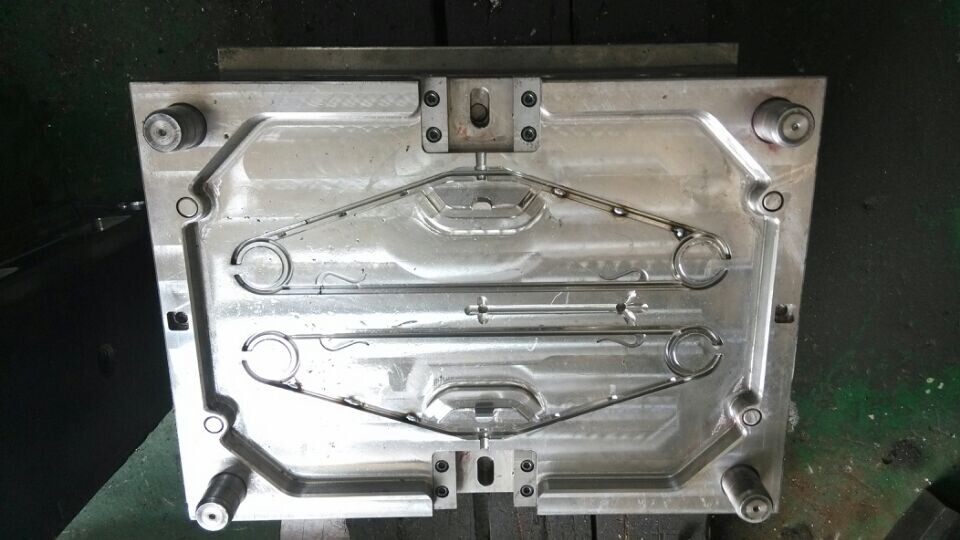
Plastic hangers are high‑volume consumer products that require efficient mold design to achieve consistent quality and production throughput. The mold design for hangers must address several specific challenges including hook hole formation, arm geometry, and structural integrity.
Side‑Action Core for Hook Hole Formation
The hook hole at the top of a hanger is typically formed by a side‑action core mechanism. During the molding process, the side‑action core slides into position to form the hook hole and retracts before ejection to allow the part to be removed. The design of the side‑action mechanism must ensure smooth operation and precise positioning to maintain consistent hole dimensions. The slide angle and travel distance are calculated based on the hook hole geometry and the available space within the mold base.
Arm Geometry and Rib Design
The arms of a hanger are typically formed with an inverted U‑shaped cross‑section to provide stiffness while minimizing material usage. Reinforcing ribs may be incorporated along the arms to improve load‑bearing capacity. The mold cavity and core must be machined to precise dimensions to achieve the desired arm profile and wall thickness distribution.
Gate Placement and Flow Balance
Gate placement affects the filling pattern and the appearance of the finished hanger. For hanger molds, the gate is typically located at one end or at the centre of the part, depending on the design requirements. Flow analysis is used to optimise gate location and ensure balanced filling of the cavity, minimising weld lines and flow marks on the visible surfaces.
Cooling System
Cooling channels in hanger molds are designed to provide uniform heat extraction across the part. Given the relatively thin cross‑section of hanger arms, efficient cooling is essential to minimise cycle time and prevent warpage. Cooling channel layout must account for the side‑action core mechanism to avoid interference during operation.
Mold Steel and Surface Finish
Hanger molds are typically manufactured from pre‑hardened steel such as P20 or 718H. The cavity surface finish must be sufficient to allow easy part release and achieve the required surface appearance. For high‑volume production, hardened steels or surface treatments may be specified to extend mold life.
 86 - 576 - 84332017
 86 - 13634093909
 No. 85 Guangshun Street, Xinqian Street, Huangyan District, Taizhou City, Zhejiang