


 English
 عربى
عربى
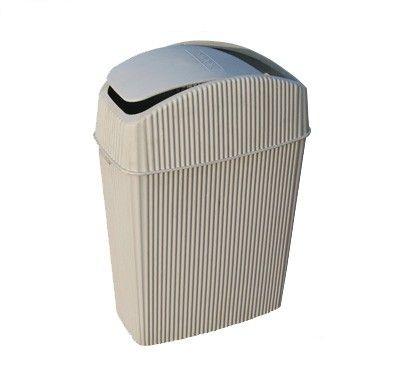
Trash cans (waste bins) are typically large components with relatively thick walls. They must withstand regular handling, stacking, and waste loading without excessive flexing or permanent deformation. Maintaining dimensional stability—especially flatness at the rim and bottom—is a common challenge in injection molding.
Warpage often results from non‑uniform shrinkage caused by uneven cooling or unbalanced filling. To mitigate these issues, mold designers focus on:
1.Reinforcing ribs and corner radii – Adding ribs at critical load‑bearing areas and using generous radii at corners (R ≥ 1.5× wall thickness) helps distribute stress and reduce shrinkage‑induced distortion.
2.Uniform cooling circuits – Multi‑layer, evenly spaced cooling channels help achieve consistent cooling across the entire part, minimizing differential shrinkage.
3.Balanced gating – Using multiple gates or a well‑designed hot runner system ensures that the melt front reaches all areas simultaneously, reducing flow‑induced residual stresses.
Material choice is typically HDPE or PP, with melt flow rates suited to large parts. Mold steel (e.g., P20 or 718H) provides adequate strength and wear resistance for long production runs. With careful attention to cooling balance and gate layout, the resulting parts show improved flatness and reduced warpage, meeting typical quality requirements for household and commercial trash containers.
In addition, the injection process itself must be controlled—for example, holding pressure and time should be tuned to avoid over‑packing, which can increase internal stresses. Many trash can molds use a sequential valve gate system to manage the filling pattern and reduce weld lines. Post‑molding dimensional checks, such as measuring rim ovality and bottom flatness, are recommended to verify that the design meets specifications. By combining robust mold construction with process optimization, manufacturers can achieve parts that remain stable even after repeated use, which is especially important for bins used in outdoor or industrial environments. The result is a longer product life and higher customer satisfaction.
 86 - 576 - 84332017
 86 - 13634093909
 No. 85 Guangshun Street, Xinqian Street, Huangyan District, Taizhou City, Zhejiang